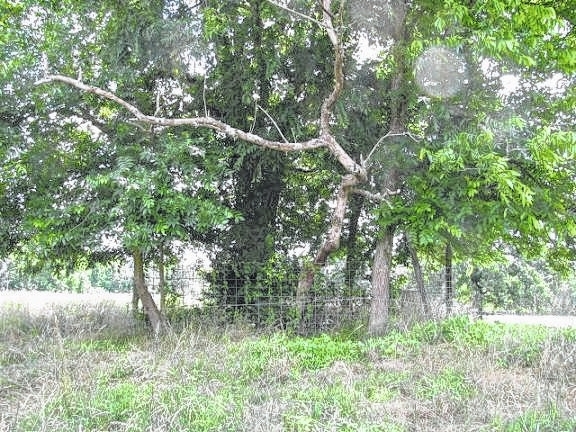
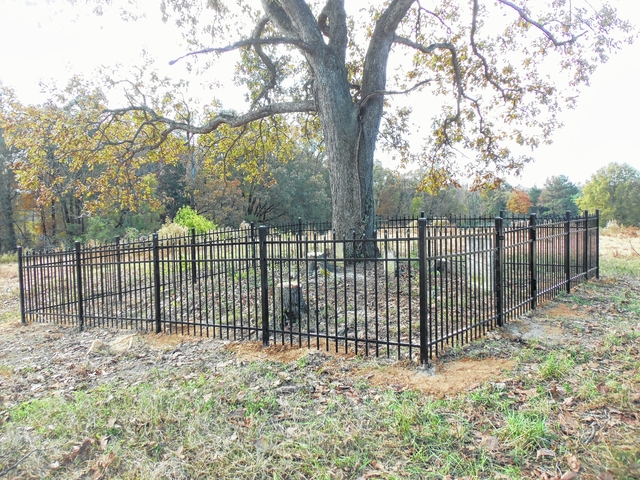
PEACHLAND — Janice Edwards feels a close connection with her ancestors, and fulfilled her dream this month to transform their resting place from a cow pasture into a maintained cemetery.
Edwards lives near Raleigh but her family has close ties to Anson County. Interested in finding out more about her family history, she researched the Rorie family, her maternal ancestors, at Ancestry.com and through relative and family history “guru” Kenneth Rorie and learned that there was a family cemetery in the White Store township south of Peachland.
The property the graveyard is on used to be a sprawling plantation filled with the main house, slave houses and a cotton gin building. Today, the farmhouse is the only structure still standing, though it has been renovated over the years.
There are three known graves remaining in the graveyard. One belongs to Edwards’ great-great-great grandmother, Nancy Petty Rorie, and is dated 1854. The other two belong to Nancy Rorie’s grandchildren, who were an infant and about 10 years old when they died. Their surname was Till, and they were the children of Susanna Rorie, who married a Confederate soldier killed during the Civil War.
The cemetery is also filled with several unmarked graves. Somewhere in there are likely the graves of Revolutionary War and French and Indian War patriot William Rorie and his two sons and their wives, among other people. Records were lost when the old Anson County Courthouse burned down.
Edwards’ great-great-great grandfather William Buxton moved to Georgia after the Civil War after selling the Rories’ land. The property was sold to a man in Charlotte, who sold it to the Billingsleys in about the 1880s, Edwards said. Their family still owns the land today.
Edwards contacted the property’s current owner, David Billingsley, and was able to visit the old graveyard. Edwards said the owners were very generous, inviting her to visit the site and giving the Rories a 20-by-20-foot area that contains the graves to do with as they liked.
“The first time I visited it, my heart sank,” Edwards said. “It was a cow pasture. It had a little enclosed chicken wire fence around it. The fence was caved in, everything was grown up so that you couldn’t see the headstones, you couldn’t get in the fence to look or walk or anything, and then there was, as you can imagine, cow (dung) all over the place. My heart sank. I just felt like we had deserted them, and with that being one of my great-grandmothers, I just felt a close connection to her, and I got fired up.”
Edwards made a website, calling upon relatives near and far to contribute to her mission to clean up the graveyard. Many responded. About 40 donated a combined amount of $2,200, which was used to buy the new fence that now encloses the site. She began collecting funds last April.
“I know this is weird, but I felt drawn to do this, and I’ve been led to things I had no clue about,” Edwards said. “I don’t know where that comes from, unless it’s just my hunger for learning.”
Edwards’ cousin, Carson Rorie, and his sons had already mended the broken tombstones a few years before Edwards decided to restore the rest of the plot.
On Nov. 12, Edwards installed a plaque that holds the Rorie family history. It was the final touch to her project.
Edwards wishes there was a way to identify the unmarked graves in her family’s plot, but said she has no way of learning the identities of those buried there. She would like to see another cemetery on the property that contains the graves of the former plantation’s slaves also restored one day. It was too overgrown and dangerous to visit the site when she visited, Edwards said.
She also hopes to learn more about her great-grandfather, Tom Rorie, and why his then-freed slaves moved beside him to Kershaw County, South Carolina, leaving his home.
In the meantime, she and other relatives are starting a sign-up list to make sure they keep the newly restored graveyard maintained.
“We’re proud of what we did,” Edwards said. “It just means a lot to us. We think of our ancestors, and we are who we are today because of what they did for us back then, and that’s my thought, that we come from them. Our thoughts are theirs, our DNA is theirs. They raised their children a certain way, and their children raised their children, so it’s been passed down.”
Reach reporter Imari Scarbrough at 704-994-5471 and follow her on Twitter @ImariScarbrough.