
Every American child knows on the night of December 24, crossing into the wee hours of December 25, Santa Claus and his fast-flying reindeer take to the skies in a sleigh heavily weighed down by presents for all the good little children who listened to their parents and teachers all year long.
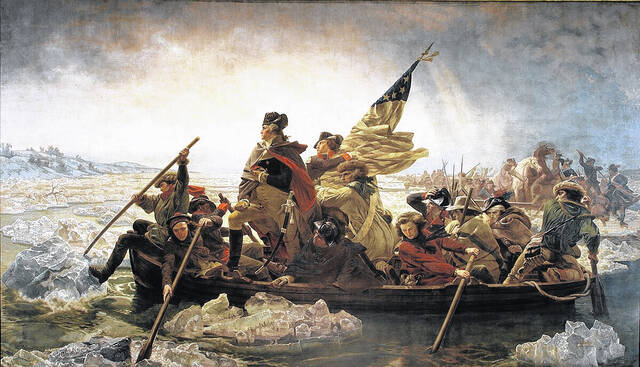
But what about America’s first Christmas? The Christmas before we could truly call ourselves Americans — the Christmas the great George Washington crossed the Delaware?
On this Christmas, homes were not bright and merry, few stockings were hung by the fireplace with care, and hardly any Christmas trees adorned homes. In the days leading up to Christmas 1776, Washington saw some of his greatest defeats. Recent losses, such as with New York and Fort Lee, forced the Continental Army to flee, leaving critical supplies and munitions behind. As many of Washington’s troops were either killed or taken prisoner, the morale of the remaining troops was continuing to plummet. Several were beginning to believe they would never win the war or gain their independence, and many soldiers’ enlistments were coming to expire. Against this backdrop of defeat, the legendary writer Thomas Paine’s “The American Crisis” was published roughly a week out from Washington’s Delaware crossing.
Seeing a hopeless look in the faces of his men, Washington ordered them to read Paine’s work, particularly its most famous passage; These are the times that try men’s souls; the summer soldier and the sunshine patriot will, in this crisis, shrink from the service of his country; but he that stands it now, deserves the love and thanks of man and woman. Tyranny, like hell, is not easily conquered; yet we have this consolation with us, that the harder the conflict, the more glorious the triumph.”
His words raised the Continental Army’s morale, inspiring many soldiers to recommit and attract new recruits at a time when the army faced shortages and possible mutiny.
Why did Washington decide to cross the Delaware?
The bold and controversial move was quite simply born out of necessity, Washington crossed the Delaware to boost the morale of the Continental Army and to serve the nearly 1,400 cocky Hessians under the command of Johann Rall occupying Trenton a slice of warm, all- American humble pie. Creating a three-stage plan for crossing the Delaware, Washington coordinated multiple crossings of the river with the goal of bewildering the Hessians and further preventing any reinforcements for them from arriving. Despite thorough planning of the attack, the Continental Army ran into harsh weather conditions and other challenges, leaving only Washington’s own forces to successfully cross.
Calling in the calvary
Washington stationed the Continental Army near McConkey’s Ferry in present-day Upper Makefield Township, close to the Delaware crossing site. Initially headquartered across from Trenton, Washington moved to the home of William Keith in Upper Makefield Township on December 15th to be nearer his troops. The Continental Army arrived with roughly 4,000 – 6,000 soldiers and about 1,700 of them needed hospital care. During the New Jersey retreat, Washington lost critical supplies and contact with two army divisions.
Washington sent out orders calling for assistance, and General Charles Lee, with a division of 2,000 troops, thundered into Washington’s camp on December 20, 1776, however, while searching for more comfortable lodging, Lee was later captured by British forces on December 12th. Prior to his arrival in camp, Lee and his men were stationed in Western, New Jersey. Not a fan of Washington’s, Lee cost the Continental Army precious time by delaying his attention to General Washington’s order. Also on December 12th, Horatio Gates’ division arrived in camp from where they had been stationed in the Hudson River valley. Gates and his men were not delayed by personal pride, as in the case of Lee, but instead by heavy snowfalls. Suffering losses as well, Gates men dwindled down to include only 600 Continental Army soldiers to secure the northern front by the time they arrived. Further supporting Washington, 1,000 Continental Army troops arrived under the command of Colonel John Cadwalader from Philadelphia. Between the three reinforcement divisions, Washington ended up with forces that totaled about 6,000 men fit for duty.
This number decreased further still, as it was incumbent on Washington to have forces guarding nearby areas such as Dunk’s Ferry or present day Neshaminy State Park in Penn., and New Hope, Penn., while still another force was deployed to guard the sick and wounded at Newtown, Penn. This left Washington about 2,400 men to cross the Delaware and then to fight against the Hessian and British troops in and around Trenton.
The morale of Washington’s men was further boosted by the timely Christmas Eve arrival of provisions, which included highly prized warm blankets.
Don’t miss next week’s American Christmas Story Part Two: The Crossing!
Leave a Reply