
NORTH CAROLINA — Here in North Carolina, our native orb weaving spiders are a familiar sight during the early Fall, with species such as spotted orb weavers and writing spiders consistently marking the changing seasons. But recently, an unfamiliar species has appeared amongst our Autumn spider assemblage – an international traveler that just might be here to stay.
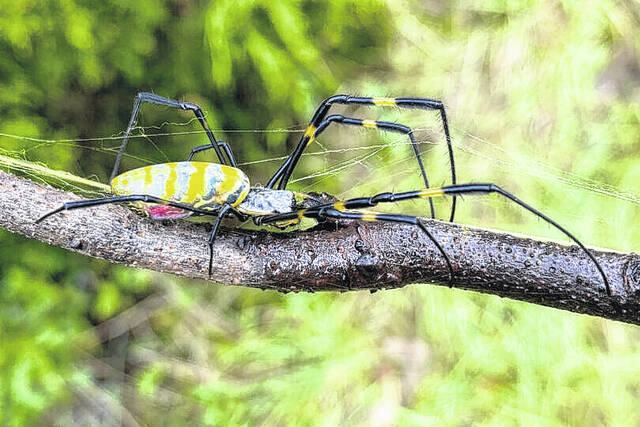
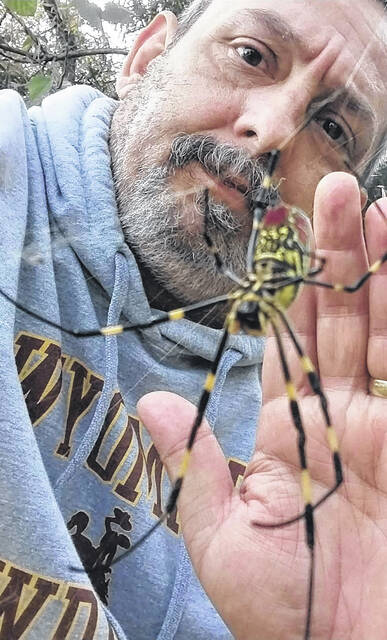
Meet the Joro spider – a brilliantly colored, palm-sized arachnid that looks like a gaudy Halloween decoration. Hailing from a native range which includes Japan and much of Western Asia, these arachnids are thought to have been mistakenly transported to the U.S on international cargo shipments. First detected near Atlanta, Georgia in 2014, Joro spiders quickly took to their new home, and were first detected in Western North Carolina in the Fall of 2021.
Their remarkable ability to disperse so effectively is made possible by a behavior called ‘ballooning’, in which young spiderlings emit a parachute-like strand of silk that they can use to ride wind currents hundreds of miles. While adults can’t fly, they can be accidentally transported by vehicles, which is especially problematic when mature females are capable of producing over 400 young per clutch.
Thankfully, despite their large size, these spiders pose no threat to humans. Their venom, a mild neurotoxin, is designed to paralyze small flying insects, and causes similar symptoms to those of a bee sting in most cases.
So now that they’re here, what exactly are Joro spiders up to? We need your help figuring that out! This invasion is recent enough that we aren’t yet sure what impact this species might be having on local ecosystems, or how quickly they are moving throughout NC.
Leave a Reply