
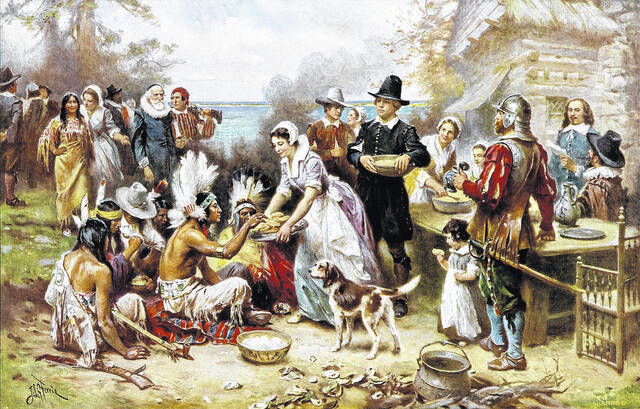
Most Americans picture the first Thanksgiving as a long table piled high with the land’s bounty and seated around it are the Pilgrims and the Native Americans- one big happy turkey loving family. But is this really the case? What was the first American Thanksgiving really like, anyway?
For starters, the Native Americans were not invited. Yeah, that part is a bit awkward to recall these days considering the historical re-write and subsequent holiday brand manufacturing by modern day corporations.
By the time the Pilgrims arrived, thriving populations of Native American tribes were well established in the area, mainly the Wampanoag, Narraganset, and Nauset. Having survived illnesses brought to them by earlier foreign visitors, their populations were severely decreased when met by the Pilgrims, but the proud people were still standing.
Initially, the relationship between the two groups was congenial, but all that changed when the Native Americans found themselves left holding the bag on the Europeans’ deceitful ways.
To be fair, actions taken by the Pilgrims were born out of necessity for survival. Alone, in a freezing foreign world, without the supplies or the skills needed to thrive in such harsh conditions, the Pilgrims resorted to grave robbing and stealing from Native Americans.
After arriving in Plymouth, and beginning construction on their new village Christmas Day, the harsh winter overcame the Pilgrims and by March of 1621, 44 souls had perished. Also, that March, a Native American who spoke English surprised the villagers when he waltzed into town and announced to the settlers they had built their village on top of what used to be a thriving Native American community, the Patuxet, but is now effectively an “Indian Burial Ground.”
The man’s name was Samoset, and the English were not only alarmed by his words, but also that they could understand him. Who was this English-speaking Native American?
A member of the Wampanoag tribe, Samoset warned the Plymouth villagers that the leader of his tribe was not happy about their chosen location and was keeping a watchful eye on their party. The Europeans expressed a desire to trade with their new friends, and a few days later Samoset returned with a few companions, all laden with furs. Another oddity, among the group was Tisquantum, who also spoke perfect English. Maybe you recognize the name, because yes, this would be every American child’s favorite Native American, the beloved “Squanto” of Thanksgiving lore. He came to tell the settlers in perfect English that their leader, Massasoit had arrived.
Fooled once, but never twice, Massasoit himself came to oversee trade negotiations, and in the end a Pilgrim named Robert Witlow was taken captive by the Wampanoag leader to ensure all was on the up and up in their dealings. A peace treaty was also established between Governor John Carver and Massasoit, promising to each protect the other should their village come under attack from outside forces. From that day forward, the Pilgrims were never hungry again under Squanto’s agricultural tutelage. He taught them how to grow crops like beans, maize, and squash. As an interpreter, Squanto was invaluable to the Europeans in more ways than one.
Squanto knew English for a dark reason. Conscripted into slavery as a youth in 1614, he was one of many Native Americans kidnapped and sent to Spain. Eventually landing in London, he was owned by a merchant who taught him English before arranging to have him returned to his homeland, or modern-day Plymouth in 1619. Squanto, originally a member of the Patuxet tribe, came home to find his village wiped out by disease. Not fully trusting the foreign speaking Squanto, Massasoit left him and another warrior behind in Plymouth to keep an eye on the budding relations between the Pilgrims and Squanto.
By November 1621 the Pilgrims had a bountiful harvest and decided to celebrate their new good fortune with a large feast. Finishing up a hunting expedition, Massasoit and his men stopped by when they heard the Pilgrims firing off celebratory rounds, effectively crashing the party. Deciding more was merrier; the hunting party was invited to stay and what followed was a three-day smorgasbord of harvest delights and fellowship: The First Thanksgiving.
Leave a Reply